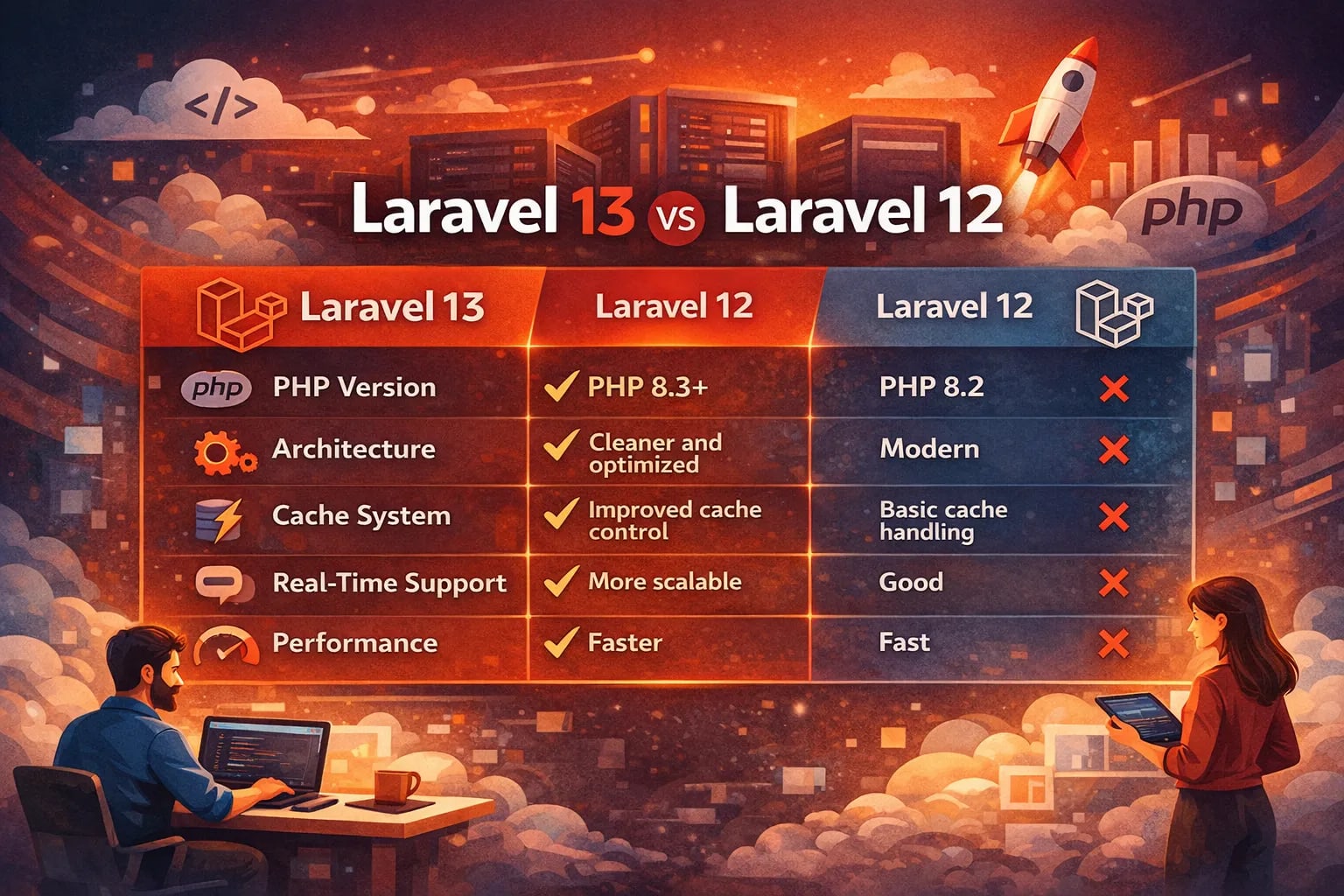
Laravel continues to evolve with the modern PHP ecosystem. Every new version focuses on making development faster, cleaner, and more scalable. Laravel 12 already introduced several improvements, but Laravel 13 pushes things further by focusing on performance, modern PHP support, and cleaner internal architecture.
In this article, we will look at the key differences between Laravel 12 and Laravel 13, along with practical examples to understand how these changes affect developers.
1. Modern PHP Support
One of the biggest differences between Laravel 12 and Laravel 13 is the required PHP version.
Laravel 13 moves fully toward modern PHP features and removes support for older versions.
| Version | PHP Requirement |
|---|---|
| Laravel 12 | PHP 8.2 |
| Laravel 13 | PHP 8.3+ |
This change allows Laravel to use newer PHP capabilities like better typing and improved performance.
Example in Laravel 13 using typed constants:
class OrderStatus
{
    public const string PENDING = 'pending';
    public const string SHIPPED = 'shipped';
}
Laravel 12 projects could still work without these stricter modern patterns.
2. Cleaner Framework Architecture
Laravel 13 focuses heavily on cleaning up internal dependencies and removing legacy support.
In Laravel 12, some backward compatibility layers were still present to support older environments. Laravel 13 removes many of these layers, which results in:
- faster framework boot time
- smaller dependency tree
- improved maintainability
This change may not affect how you write code directly, but it improves application performance.
Example of a simple route (same syntax but faster internally):
Route::get('/users', function () {
    return User::all();
});
The difference is mostly internal optimization.
3. Improved Cache Handling
Laravel 13 introduces improvements to the caching system. One example is the new ability to refresh cache expiration without rewriting the cache.
Example:
Cache::put('user_1', $data, 600);
Cache::touch('user_1');
Here, the cache expiration time can be refreshed without updating the stored value.
In Laravel 12, developers often had to rewrite the cache manually:
Cache::put('user_1', $data, 600);
Laravel 13 makes cache handling more efficient for frequently accessed data.
4. Better Real-Time Application Support
Real-time applications are becoming more common. Laravel 13 improves support for WebSockets and real-time features.
This helps developers build applications such as:
- live chat systems
- real-time notifications
- dashboards with live data updates
Example event broadcasting:
broadcast(new MessageSent($message));
While Laravel 12 supported broadcasting, Laravel 13 improves scalability for distributed systems.
5. Improved Developer Experience
Laravel has always been known for its developer-friendly environment. Laravel 13 adds improvements in command-line tooling and project structure.
Developers can generate structured components more easily.
Example:
php artisan make:service PaymentService
This kind of structured generation encourages cleaner architecture in larger applications.
In Laravel 12, developers often had to manually organize these layers.
6. Performance Improvements
Laravel 13 includes multiple internal optimizations.
Developers may notice improvements in:
- API response time
- request handling
- memory usage
This makes Laravel 13 particularly useful for high-traffic applications and SaaS platforms.
Laravel 12 vs Laravel 13 Quick Comparison
| Feature | Laravel 12 | Laravel 13 |
|---|---|---|
| PHP version | PHP 8.2 | PHP 8.3 |
| Architecture | Modern | Cleaner and optimized |
| Cache system | Basic cache handling | Improved cache control |
| Real-time support | Good | More scalable |
| Performance | Fast | Faster |
Should You Upgrade?
If your application already runs on Laravel 12 and PHP 8.3, upgrading to Laravel 13 should be relatively smooth. The upgrade mostly improves performance and modernizes the framework rather than introducing major breaking changes.
For new projects, Laravel 13 is the better choice because it provides a cleaner foundation and better long-term support.
Final Thoughts
Laravel continues to mature as one of the most powerful frameworks in the PHP ecosystem. Laravel 13 doesn’t dramatically change how developers write code, but it improves what happens behind the scenes.
With better performance, modern PHP integration, and improved developer tooling, Laravel 13 is a solid step forward for building scalable web applications.

Rohit Maurya
Verified CreatorAn expert contributor at CoolPosts, sharing insights on Web Technology and digital innovation.